Place a disc to trap an opponent's line, then flip every trapped disc to your color. Black goes first. Players alternate legal moves until neither can move. The player with more discs of their color on the board wins.
Start with four discs in the middle.
Othello is played by two people on an 8 × 8 board with 64 double-sided discs. Each player has a color: black or white. In the standard opening, D4 and E5 are white; E4 and D5 are black. Columns run A to H, and rows run 1 to 8 on this site's board. Black moves first.
The four center discs are already set up in our online Othello game. You do not place those discs as your first four turns. In computer mode you play black, while the computer plays white.
A legal move makes a sandwich.
Choose an empty square where your new disc will trap one or more opposing discs between itself and another disc of your color. The trapped discs must be in a continuous straight line: horizontal, vertical or diagonal. An empty square breaks the line, and you cannot jump over your own discs to capture a second group.
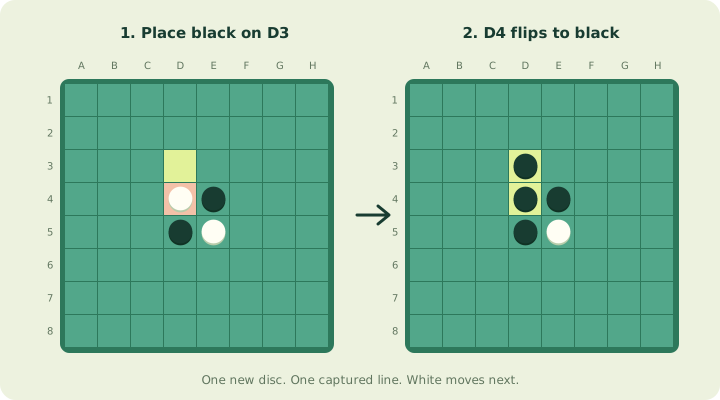
Black has four legal first moves: D3, C4, F5 and E6. For example, playing D3 traps the white disc at D4 against the black disc at D5. D4 flips to black, leaving four black discs and one white disc. White then takes a turn.
Flip every line your move closes.
A single move may capture in several directions. Check all eight directions from the new disc and flip every opposing disc in every closed line. You must take all captures made by that placement; you cannot choose to leave a captured disc unchanged.
Only lines closed directly by the newly placed disc count. Flipping an existing disc does not start a chain reaction of extra captures elsewhere. A legal move always places exactly one new disc, even when many older discs flip. This browser game checks the lines and performs those flips for you.
No legal move? Pass automatically.
If you cannot capture at least one opposing disc, you have no legal move and must pass. Your opponent takes another turn. You cannot pass voluntarily when a legal move exists, and passing does not remove any discs from the board.
It is possible for one side to move several times in a row if the other side keeps having no legal move. Our game displays the pass and continues with the correct color. A short list of available moves is not the same thing as being forced to pass: even one legal move means you must play.
Count the discs at the end.
The game ends when neither player has a legal move. A full board is one way to reach that point, but a game can also finish with empty squares remaining. Count the black discs and white discs on the board: the larger count wins, and equal counts make a draw.
During play, the displayed scores are a count of the current position. An early lead is not a final result. In this casual implementation, the final score counts discs actually on the board; it does not award empty squares to either color. Tournament recording conventions may differ.
Your first game, without the guesswork.
- Open the board and leave Show moves switched on.
- Choose Easy to learn the rhythm, or 2 players to share a screen.
- Place black on one of the dotted squares and watch which discs flip.
- After each move, check whose turn is highlighted.
- Use Undo to revisit a decision, or New game for a fresh board.
Once the placement rule feels familiar, read our beginner strategy guide. The next useful idea is learning why a move that gains fewer discs can still be the better move.